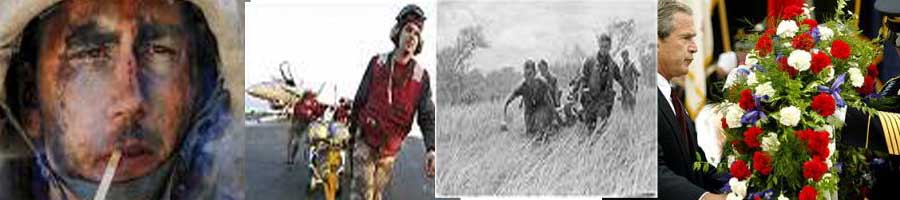
We send them to battle for rights and freedom, and they do so without question or regard to their personal safety. We know many will be killed and many will have wounds they carry for life. Some wounds are not visible to the naked eye, but the look in our warrior's eyes tells more.
They march to the sound of the guns, and follow the commands of their leaders without hesitation, and trust their fellow warriors to do the same. Some fall never to rise again, but the battles go on until the last breath of freedom's air is consumed, or the day is won.
These warriors carry the title of United States Marines.
As one of those warriors who has long since set his weapons aside, what I was then is who I am today. I am a warrior, but I'm fighting a different battle, fought a different way with different weapons. I see from my own experience how our warriors have to battle for what is their entitlement. We were not trained for these battles and do not have the weapons of our opposing forces, but we will march forward without retreat on our minds.
Here is my reconnaissance:
Based on my personal experience, and current research years of untreated PTSD put Veterans at high risk for heart disease. The problem is connecting the dots between Heart Disease and the ethological cause. PTSD may put the Veteran at high risk, but many of the VA Doctors have difficultly saying that PTSD is the cause so the Veteran’s claim is returned denied.
As a Doctor, outside the VA, that examined me stated that if PTSD was not the ethological cause it almost certainly lead to the aggravation and accelerated the progression. So it comes down to age old question which came first the chicken or the egg. My claim bounced back and forth between Doctors outside the VA, and different Doctors within the VA. Each denial I received was not well researched, or at least the latest research. Each denial and appeal can take up to six months plus taking it up to a year plus to have a discussion about the difference of opinions between Doctors.
Adding to the problem can be the diagnoses within the treatment records. There can be several different names given to a symptom of heart disease. Then the Doctor making a determination of the connection of the Veteran’s heart problem and PTSD.
This not only confusing to the Veteran without the medical background, but difficult for the Doctors with a medical background. So the evidence falls within the responsible of the Veteran, and the Veteran is left without a clue of how to proceed.
The Veteran can do as I did go to a Major Medical Teaching Institution that in addition to teaching stays current with all the latest research. I regret to say it has done no more than get me scheduled with another VA Doctor that is not as current, but can refute the outside Doctor enough to have the claim denied. I have spoken to a Veteran Advocate that admits the process can be frustrating, as well as, terminal for the Veteran. He helped in getting an award for a Veteran that took over 10 years. Sadly the Veteran had passed away and his spouse had to continue the claim then after 10 years, and many denials the claim was awarded.
My personal situation, and thousands of other Veterans are in the same pickle. Fighting a claim is not how our Countries Warriors need to spend their few remaining years, but it is a nature of bureaucracy (a polite word for ignorance). Sadly this all could have been avoided for the majority of our Veterans if they had been screened for PTSD, and followed up for the first few years of their discharge. It is not that our VA has not been aware of PTSD and its’ impact on Veterans because it has been documented since the Civil War times.
My treatment at the VA has been excellent, and I have no complaints. Only my gratitude and many thanks for the health care they have provided. Without them I would not be here today, or have the quality of life I enjoy. My heart condition is not reversible, nor is my thanks to the VA.
Your Country is on your side, but it is up to us to fight the battle.